
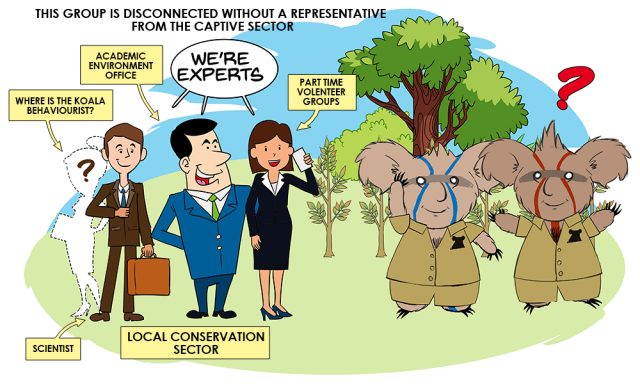
For councils to win the battle into the future and reduce the amount of roadkill on Appin and Picton road, then a number of different programs need to be supported their fencing solution. The fencing suggestion by both Campbelltown & Wollondilly councils focusing on redirecting their koala's movements also needs to support them at the same time. Fencing alone won't win the battle - knowing the type of behaviourist is the missing link! The biggest hurdle for councils will be creating a group of professionals; newly formed groups to tackle each and every road bend and improve the landscape to give the koalas the illusion of free-will. One of the biggest decisions is whether they will allow someone from the captivity sector to be part of their koala group. The captive sector creates different behaviour programs to give koalas an enrichment program whilst in the smaller area of space. So why not reach out to different behavioural specialists? We use food as one of many tools to understand the koala's personality and temperament. We've already described our behaviour across the two industries in Article 7, 'Inside out, and Outside in', so why not think outside the box?
1. Our behaviour of protection
2. Sequence and layers of disconnect
3. Our balance of behaviour
4. Acceptance
Our Behaviour of Protection
This first element investigates the term PROTECTION and many groups and entries that all have different interpretations of this word.
By combining these elements and dissecting them even further we can see that both the captive-conservation sector (free-range conservation sector) share two main differences yet still have something in common, which is prioritizing the survival of this animal in the long term. How do we get there when we have two different approaches and two different interpretations and different meanings of another word, "Accountability" from the two different sectors?
This is much harder in the conservation sector because of a wide range of outside influences, and for inexperienced people and groups tend they become secretive when mistakes are made, compare to the captivity sector where mistakes are easily seen and then dealt with as soon as possible. And yet, in the conservation sector, they have a different approach and culture, especially politically motivated conservationist, who, (in some cases, but not all) instead of acknowledging their mistakes or humbling themselves, they bunker down and block professional advice to suit their own needs. I couldn't believe this would happen in my own backyard. Here is an example of a micro situation, where many people who never had any prior experience with koalas, took over, avoiding basic koala care, simply because of their position within the community!
If you're interested to see this behaviour in a micro way and in the local way visit:
The main question is the extent of our supervision over native animals and our perception of the word "conservation". That's referring to both free range and captive circumstances. To me, the word comes with four essential elements. Australia's east coast needs looking at in the macro and micro.
Here, we will apply the Four Main Elements. Each element has its own form of limitation and creativity that could easily suit both the captive and free-range sectors (aka the conservation sector). This at least gives us a template to begin, with guiding principles to consider when adopting these practices in every aspect of koala management, regardless of their situation.
1. Our behaviour of protection
2. Sequence and layers of disconnect
3. Our balance of behaviour
4. Acceptance
Our Behaviour of Protection
This first element investigates the term PROTECTION and many groups and entries that all have different interpretations of this word.
By combining these elements and dissecting them even further we can see that both the captive-conservation sector (free-range conservation sector) share two main differences yet still have something in common, which is prioritizing the survival of this animal in the long term. How do we get there when we have two different approaches and two different interpretations and different meanings of another word, "Accountability" from the two different sectors?
This is much harder in the conservation sector because of a wide range of outside influences, and for inexperienced people and groups tend they become secretive when mistakes are made, compare to the captivity sector where mistakes are easily seen and then dealt with as soon as possible. And yet, in the conservation sector, they have a different approach and culture, especially politically motivated conservationist, who, (in some cases, but not all) instead of acknowledging their mistakes or humbling themselves, they bunker down and block professional advice to suit their own needs. I couldn't believe this would happen in my own backyard. Here is an example of a micro situation, where many people who never had any prior experience with koalas, took over, avoiding basic koala care, simply because of their position within the community!
If you're interested to see this behaviour in a micro way and in the local way visit:
Koala Protection in Mulgoa
In the free-range conservation sector, there are too many societal and human-behavioural influences that set back all the good work. But in captivity, the environment is greatly reduced, and any unforeseen errors are quickly discovered. In captivity, any shortfalls are emphasized much more and require a much more intensive approach toward the koala.
The captive sector has, in general, the experience and, in most cases, the infrastructure to compensate for any shortcomings. However, for some reason, conservationists and government officials choose to ignore or are unaware of what's in front of them and adopt a different methodology of understanding the koala in the form of protection from a distance.
Their work clashes with a society that has become too formal in an environment that never stops moving. Our formal way of redevelopment has become restrictive and rigid even for the koala. As we increase our Australian population, there are still opportunities to bridge this gap of the captive and conservation sectors. In a way that will provide the conservation sector with more flexibility using atypical practices on the conservation front. By introducing captive management practices, this will allow for a more direct mode of operation, in an open environment, which will always have its own set of unique limitations. In today's format, there are too many societal and human-behavioural influences that set back all the good work. But in captivity, the risk is greatly reduced, the only setbacks that I can see for the captive sectoris inexperience and the type of business structure as they too are influenced by short-term investments.
The knowledge gained in the captive sector doesn't fit the approach of the conservation methods, but it can, with some adjustments. The problem is the way information is received in the conservation sector, in terms of handling and capturing and a range of other issues like relocation methods. This information is given in several ways, from word of mouth to the higher levels of the zoological industry to the State government which then gets transferred to the higher levels of the conservation sector. However, that information is trickled down in a range of emotions and the way in which it is delivered has different effects to the new-comer in the koala industry. Plus, by the time information gets to the foot-soldier sometimes years later, what also doesn't get through is the ongoing changes to the needs of the koala. There are always new methods and practices which are highly dependent on a variety of unpredictable circumstances (such as the size of koala population in captivity, and the different ways to manage them, their size, location, feeding changes and the general environment), and this type of information doesn't find its way when passing information from the highest levels, down.
What you might do with one or two koalas, you don't do with 20 or 30 koalas; the dynamic changes as this creates different types of layers and sub-layers as the population grows. In captivity, it's all about the numbers, and the infrastructure supporting those numbers, its different from one location to the next, because of the general environment and the culture of each wildlife park or zoo. There is a slight difference between each park and zoological institution's methods, and even from state to state, this type of information and the change in each skill-set, most of the time doesn't find its way when passing information from the highest levels.
I noticed a big change from working in Queensland to San Diego and again here in NSW. The standard here is much lower, the intensity was dramatically decreased. The culture in NSW from around 2001, until today, has slowly been declining which is exemplified by the huge turnover of experienced staff. And I've noticed a widening gap, even amongst the younger generation who simply can't sometime process my language even if I support their cause. Maybe it's me and my mentality in this industry, as the culture has changed. There is a totally different spin and story-line now, that I can't believe the slow decline of long-term thinking, which is coming from the business side of the captive sector. I'm slowly becoming disconnected from this newer generation of koala keepers.
The sequence and layers of disconnect
To understand this element, it's both society's interpretation and the work involved.
So, you get one type of information from the highest level of the zoological industry and then pass that information to a group of conservationists on the ground. This information is usually spun to fit or suit their own experiences and interpretation as there is no on-site training from experiences given, basing the situation on the environment, and the task at hand. Most of the time the information given is coming from a formal captive perspective, (as there's both a formal process and informal process) yet the smaller wildlife parks practice different husbandry methods and dietary methods, where the local conservation group may only deal with a handful of koalas, except places like Campbelltown who are dealing with around 200 koalas.
Still what I'm mainly talking about is a more practical solution, even for a large population like Campbelltown. So, any koalas suffering from stress can be housed in the short term, and by introducing certain captive practices allows us to understand their personality and temperament from a close proximity. Then we can relocate them in an area suited to their dietary behaviour. So when you're receiving information from a formal setup such as large zoological institutions when in fact, or you need is, a different perspective from a small to medium size koala wildlife park.
It is about understanding how formal you need to be; creating that balance according to the population size and the local environment and the purpose, to begin with. Having that main objective is crucial when setting up, for instance, captive management practices in a conservation environment. Knowing that long-term goal is important when setting up your koala program, allows them to be released to an environment in a soft way, rather than a hard one. (As there are two approaches when releasing koalas back into their own environment or new environment).
With the ever-increasing Australian population, we now must acknowledge our behaviour clashes with our way of managing koalas in the wild. We are still not recognising that we have to be more flexible, and that koala conservation is actually blue-collar work. And because of this, we need to set up the preliminary work behaviour in a way that works for each local environment and then set this information up to the white-collar folks to ensure procedures are in place that allows for flexibility and change. Because the environment never stops changing. And if you don't notice the change in the environment then there is a disconnect as the koala keeps moving around, only coming back to a given area when it is suitable to them, not us.
Everyone - even in the captive sector in higher positions - loses that incremental knowledge that's the current state of information. They also become disconnected even though they are in the zoological industry. The best people to pass on the knowledge are the very people currently dealing with koalas on a day to day operational level. They are the ones who need to pass on the information, directly to the very people volunteering for the work. The work itself is labour intensive, and the action-packed nature of the work weeds out the individuals who aren't cut out for the constant work that's required. This makes it hard to tell them this, as it's a non-paying role. To fix that is to pay people who are comfortable with hard work and start paying committed people a wage. An example is Lyn Bowden, whose commitment over two decades in the Campbelltown area is very impressive. See article 15. It takes only the exceptional individuals to make a program. A natural order of competition amongst the volunteer group while slowly changing and improving our wildlife conservation groups which also includes "WIRES" can benefit. EVERYBODY wants' their work to mean something and last as long as possible, this behaviour will allow the flow-on effect to the next set of working programs. Otherwise, like in the captive sector, volunteers and paid people will leave - and they do! Being a volunteer, you need thick skin, as the work is not celebrated or glamorous. But again, with proper training at least this can be clarified, with ongoing intervention. But again, it's a lot of work, turning a volunteer program with people who are part-time, run by an organization, such as "WIRES", into half-paid and half-not. All these layers are a set of disconnections for a society confused with why we are not winning.
One half of the problem is the fragmentation of the koala habitat, the other half is the fragmentation of society itself; not coming to terms with modernity/flexibility. And the old ways aren't coming back, society isn't going to slow down, so why not catch up with that speed and find a way to maintain the speed? And one day surpasses the speed of society's infrastructure and coordinate new housing estates to allow the domination of native vegetation, as native flora and fauna will be a selling point just like the NBN was at the beginning.
On a State Level;
1.Government officials
2.Council officials
3.Council environmental officials which included
4.Ecologist and maybe Biologist
5.Professors of the local university
6. And koala volunteers
7.Local Koala Action groups
This is great, the disconnect is that we rely too heavily on scientists and academics to solve this problem. For some reason, society believes that to get the best result we must turn to individuals with tertiary education - people with the highest form of education, to solve all our koala concerns. This can't be further from the truth. In fact, it's only 50% right. The other 50%, should be made up of other professions and everyday individuals who've shown grit and worked hard for a cause that they believe in.
So, the Summit itself, hopefully, will be on how to delegate the work, and which industry needs the most attention. By drawing out layers of different industries to work together step by step, we can get the best form of behaviour to reach an outcome. So that when society starts an environmental task they will finish the project better than they found it! A COMBINATION of an academic point of view, as well as labour forces that work together.
1. Council heads of the environment department
2. Koala Captive management Consultants
3. A range of wildlife parks and zoos institutions
4. Building Architects
5. Property developers
6. Landscape designers
7. Experienced koala keepers
8. Farmers and landowners
Not trying something different can create MORE unnecessary set-backs to the efforts in the past of koala conservation, as we stay on the same road as before, going around and around, with no major changes.
These are all forms of disconnect. The lack of training in the conservation sector compared to the constant repetitive workload in the captive sector (which is the best form of training and training your brain), to a level of understanding where emotions are removed, and decision-making is much more logical. This helps set out many layers for and against when making a decision that will affect your koala's behaviour. Everything has a follow-on effect. When working with koalas at an intermittent level, in a true culture of a koala park (that relies on the income of the koala itself), you see a different side of the work itself, the amount of work behind the scenes. The next layer of understanding the koala is what's the best form of our behaviour and understanding the barriers that exist within us as individuals and as a society and the process forming those barriers, which leads us as a society to a negative cycle which we are in. We need to clarify and talk about these unspoken truths, for better or worse.
Here in Mulgoa - Penrith NSW we have high-standards, So when we are seeing the effect of warm winters and my local conservation group believe, they know best when a koala enters the community for the first time in 50-80 years. Anyway, their decision to transfer one koala from a location along the Nepean River to a dryer part of Mulgoa seems to be a political step for control rather than being in the best interest of this little guy. This is just another layer of disconnect, where entitlement and ego rear its ugly head as emotions run high for the inexperienced members of our local group. To read more on the local level on go: Disconnect In Mulgoa
52 Articles, 4 themes 1 story
www.koalaretreat.com
In the free-range conservation sector, there are too many societal and human-behavioural influences that set back all the good work. But in captivity, the environment is greatly reduced, and any unforeseen errors are quickly discovered. In captivity, any shortfalls are emphasized much more and require a much more intensive approach toward the koala.
The captive sector has, in general, the experience and, in most cases, the infrastructure to compensate for any shortcomings. However, for some reason, conservationists and government officials choose to ignore or are unaware of what's in front of them and adopt a different methodology of understanding the koala in the form of protection from a distance.
Their work clashes with a society that has become too formal in an environment that never stops moving. Our formal way of redevelopment has become restrictive and rigid even for the koala. As we increase our Australian population, there are still opportunities to bridge this gap of the captive and conservation sectors. In a way that will provide the conservation sector with more flexibility using atypical practices on the conservation front. By introducing captive management practices, this will allow for a more direct mode of operation, in an open environment, which will always have its own set of unique limitations. In today's format, there are too many societal and human-behavioural influences that set back all the good work. But in captivity, the risk is greatly reduced, the only setbacks that I can see for the captive sector
The knowledge gained in the captive sector doesn't fit the approach of the conservation methods, but it can, with some adjustments. The problem is the way information is received in the conservation sector, in terms of handling and capturing and a range of other issues like relocation methods. This information is given in several ways, from word of mouth to the higher levels of the zoological industry to the State government which then gets transferred to the higher levels of the conservation sector. However, that information is trickled down in a range of emotions and the way in which it is delivered has different effects to the new-comer in the koala industry. Plus, by the time information gets to the foot-soldier sometimes years later, what also doesn't get through is the ongoing changes to the needs of the koala. There are always new methods and practices which are highly dependent on a variety of unpredictable circumstances (such as the size of koala population in captivity, and the different ways to manage them, their size, location, feeding changes and the general environment), and this type of information doesn't find its way when passing information from the highest levels, down.
What you might do with one or two koalas, you don't do with 20 or 30 koalas; the dynamic changes as this creates different types of layers and sub-layers as the population grows. In captivity, it's all about the numbers, and the infrastructure supporting those numbers, its different from one location to the next, because of the general environment and the culture of each wildlife park or zoo. There is a slight difference between each park and zoological institution's methods, and even from state to state, this type of information and the change in each skill-set, most of the time doesn't find its way when passing information from the highest levels.
I noticed a big change from working in Queensland to San Diego and again here in NSW. The standard here is much lower, the intensity was dramatically decreased. The culture in NSW from around 2001, until today, has slowly been declining which is exemplified by the huge turnover of experienced staff. And I've noticed a widening gap, even amongst the younger generation who simply can't sometime process my language even if I support their cause. Maybe it's me and my mentality in this industry, as the culture has changed. There is a totally different spin and story-line now, that I can't believe the slow decline of long-term thinking, which is coming from the business side of the captive sector. I'm slowly becoming disconnected from this newer generation of koala keepers.
The sequence and layers of disconnect
To understand this element, it's both society's interpretation and the work involved.
So, you get one type of information from the highest level of the zoological industry and then pass that information to a group of conservationists on the ground. This information is usually spun to fit or suit their own experiences and interpretation as there is no on-site training from experiences given, basing the situation on the environment, and the task at hand. Most of the time the information given is coming from a formal captive perspective, (as there's both a formal process and informal process) yet the smaller wildlife parks practice different husbandry methods and dietary methods, where the local conservation group may only deal with a handful of koalas, except places like Campbelltown who are dealing with around 200 koalas.
Still what I'm mainly talking about is a more practical solution, even for a large population like Campbelltown. So, any koalas suffering from stress can be housed in the short term, and by introducing certain captive practices allows us to understand their personality and temperament from a close proximity. Then we can relocate them in an area suited to their dietary behaviour. So when you're receiving information from a formal setup such as large zoological institutions when in fact, or you need is, a different perspective from a small to medium size koala wildlife park.
It is about understanding how formal you need to be; creating that balance according to the population size and the local environment and the purpose, to begin with. Having that main objective is crucial when setting up, for instance, captive management practices in a conservation environment. Knowing that long-term goal is important when setting up your koala program, allows them to be released to an environment in a soft way, rather than a hard one. (As there are two approaches when releasing koalas back into their own environment or new environment).
With the ever-increasing Australian population, we now must acknowledge our behaviour clashes with our way of managing koalas in the wild. We are still not recognising that we have to be more flexible, and that koala conservation is actually blue-collar work. And because of this, we need to set up the preliminary work behaviour in a way that works for each local environment and then set this information up to the white-collar folks to ensure procedures are in place that allows for flexibility and change. Because the environment never stops changing. And if you don't notice the change in the environment then there is a disconnect as the koala keeps moving around, only coming back to a given area when it is suitable to them, not us.
Everyone - even in the captive sector in higher positions - loses that incremental knowledge that's the current state of information. They also become disconnected even though they are in the zoological industry. The best people to pass on the knowledge are the very people currently dealing with koalas on a day to day operational level. They are the ones who need to pass on the information, directly to the very people volunteering for the work. The work itself is labour intensive, and the action-packed nature of the work weeds out the individuals who aren't cut out for the constant work that's required. This makes it hard to tell them this, as it's a non-paying role. To fix that is to pay people who are comfortable with hard work and start paying committed people a wage. An example is Lyn Bowden, whose commitment over two decades in the Campbelltown area is very impressive. See article 15. It takes only the exceptional individuals to make a program. A natural order of competition amongst the volunteer group while slowly changing and improving our wildlife conservation groups which also includes "WIRES" can benefit. EVERYBODY wants' their work to mean something and last as long as possible, this behaviour will allow the flow-on effect to the next set of working programs. Otherwise, like in the captive sector, volunteers and paid people will leave - and they do! Being a volunteer, you need thick skin, as the work is not celebrated or glamorous. But again, with proper training at least this can be clarified, with ongoing intervention. But again, it's a lot of work, turning a volunteer program with people who are part-time, run by an organization, such as "WIRES", into half-paid and half-not. All these layers are a set of disconnections for a society confused with why we are not winning.
One half of the problem is the fragmentation of the koala habitat, the other half is the fragmentation of society itself; not coming to terms with modernity/flexibility. And the old ways aren't coming back, society isn't going to slow down, so why not catch up with that speed and find a way to maintain the speed? And one day surpasses the speed of society's infrastructure and coordinate new housing estates to allow the domination of native vegetation, as native flora and fauna will be a selling point just like the NBN was at the beginning.
We had a koala summit the other day, At Campbelltown NSW on the 11th of September filled with:
1.Government officials
2.Council officials
3.Council environmental officials which included
4.Ecologist and maybe Biologist
5.Professors of the local university
6. And koala volunteers
7.Local Koala Action groups
This is great, the disconnect is that we rely too heavily on scientists and academics to solve this problem. For some reason, society believes that to get the best result we must turn to individuals with tertiary education - people with the highest form of education, to solve all our koala concerns. This can't be further from the truth. In fact, it's only 50% right. The other 50%, should be made up of other professions and everyday individuals who've shown grit and worked hard for a cause that they believe in.
So, the Summit itself, hopefully, will be on how to delegate the work, and which industry needs the most attention. By drawing out layers of different industries to work together step by step, we can get the best form of behaviour to reach an outcome. So that when society starts an environmental task they will finish the project better than they found it! A COMBINATION of an academic point of view, as well as labour forces that work together.
Now we are living in an age of inflexibility and bureaucracy when we once enjoyed large tracts of bush and open areas, that's all changing now!
The Next Summit should be filled with:
1. Council heads of the environment department
2. Koala Captive management Consultants
3. A range of wildlife parks and zoos institutions
4. Building Architects
5. Property developers
6. Landscape designers
7. Experienced koala keepers
8. Farmers and landowners
The sequence of events where the right layers come into place, to maximize efficiency, just like nature has done with the way the Earth was made. Understanding the layers of the Earth gives an insight into society and how we should behave and perform when making decisions on what's best for the koala. And we can start small with a project of 50 houses, which should include everyone. WHERE THE OUTCOME per square meter is a balance of 30% housing, 70% native flora and fauna.
Not trying something different can create MORE unnecessary set-backs to the efforts in the past of koala conservation, as we stay on the same road as before, going around and around, with no major changes.
These are all forms of disconnect. The lack of training in the conservation sector compared to the constant repetitive workload in the captive sector (which is the best form of training and training your brain), to a level of understanding where emotions are removed, and decision-making is much more logical. This helps set out many layers for and against when making a decision that will affect your koala's behaviour. Everything has a follow-on effect. When working with koalas at an intermittent level, in a true culture of a koala park (that relies on the income of the koala itself), you see a different side of the work itself, the amount of work behind the scenes. The next layer of understanding the koala is what's the best form of our behaviour and understanding the barriers that exist within us as individuals and as a society and the process forming those barriers, which leads us as a society to a negative cycle which we are in. We need to clarify and talk about these unspoken truths, for better or worse.
On a local level, my microcosm
Here in Mulgoa - Penrith NSW we have high-standards, So when we are seeing the effect of warm winters and my local conservation group believe, they know best when a koala enters the community for the first time in 50-80 years. Anyway, their decision to transfer one koala from a location along the Nepean River to a dryer part of Mulgoa seems to be a political step for control rather than being in the best interest of this little guy. This is just another layer of disconnect, where entitlement and ego rear its ugly head as emotions run high for the inexperienced members of our local group. To read more on the local level on go: Disconnect In Mulgoa
Next Article 24B The last blog of this theme
52 Articles, 4 themes 1 story
www.koalaretreat.com


