
The koala industry has become complacent. While the conservation sector is losing the battle to save koala habitat, the captive sector is stuck in its traditional and conservative modus operandi and is reluctant (and unwilling) to push boundaries and innovate.
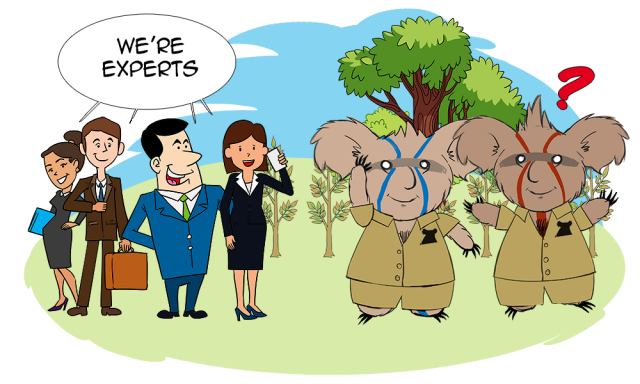
The over-use of the term Koala Experts
In the captive sector, a koala captive manager is a person who can build, house and understand koala behaviour, biology, AND source koala food from both plantation/ and the old school way of field browsing, in and formal dietary process for their koala population.
Feeding koalas in large numbers - 50 or more koalas per day - is a totally separate set of skills, compared with managing them in-small numbers, from 1-5 koalas. There are unique sets of rules and skills that comes into play for large-numbers, still in certain parts of the captive sector have fail to notice the degree of layers involved. The government base zoological institutions have separate different roles, departmentalize the work involve for their koala husbandry work, though these roles are meant to overlap and work together as one. Small-medium wildlife parks still manage koala husbandry the old school way, where the koala keeper, does all the work themselves.
Conservationists regularly use the term "koala expert", particularly in the media, as it establishes superior understanding and provides the community with a sense of trust in the conservation community.
Knowing that no-one will challenge them and their "expertise", this title drowns out the voice of anyone else in the community who may also have value to add. To me, the koala experts are the individuals who have a set of skills that range over several different working environments - like several small pieces of a puzzle - that both directly and indirectly contributes towards the koala welfare and conservation daily.
Credentials for Koala Conservation Groups
Conservationist who map koalas and watch over them across wide areas have a different skill-set to people that work in the captive sector handling koalas daily. Sure, in the wild, they need to change their radio collar for medical and research reason, but, otherwise these koala groups are just monitoring their movements and collecting data. In my opinion, they should be referred to as "koala habitat trainees", and they can perhaps be known as "koala habitat volunteers" after a few years on the job. And for the Australian Koala Foundation and their local Redland bank koalas, their employees could be called "koala habitat trainees or specialist", not just the common term of koala experts. It's important to separate these terms.
The captivity sector has a set of completely different roles to the conservation sector. Conservationists generally work from a distance within limited time frames. They prefer not to handle the koalas as they manage the environment in which the koala lives in. Then there are different management styles which come with a whole new and unique set of skills and problem solving tactics such as preventative work, which ensures that captive institutions are not falling behind and constantly playing "catch-up" in their husbandry duties. Every wildlife institution has their own work culture, their own set of circumstances and their own challenges and approaches to managing koalas.
Changing society Conscious
The term "expert" should be divided into specialized categories and used with more care and thoughtfulness. Clearer language will ensure that the general public is not confused, that the media is not unknowingly misguiding anyone, and that professionals and experts are being hired to consult on areas that they are actually expert in.
Dignity for Field Workers
Certain individuals who spend countless hours volunteering and dedicate their professional career to expanding their knowledge. Should be identify and respected as some who knows their local environment as they live and breed that local environment and seen it in many different light.
Lyn Bowden is an example of this; a woman who spent most of her adult life working alongside Professor Rob Close to collect data and further research for Campbelltown's koalas along the George's River. Though she is semi-retired now, Lyn represents the quintessential community leader in the term of her local koala group I would class her as a koala habitat volunteer/consulate, and if she was supported and received an income from the council she would be known as a Koala habitat consulate for her local community, basically of her intermitted knowledge of koala lineage, and a number of male koala home range as well as a number females home-range.
She quietly goes about her job and her commitment (and the outcomes for koalas that she creates) is on par with other leading figures in the community. Lyn has great local knowledge of the social structure of koalas in her area. However, her work style - like so many in her situation - is from a distance, as conservationist don't believe in too much human contact. Whereas on a professional level we would be handling them daily creating those skill-sets with koalas.
Our society is structured in a way that elevates the social and professional standing of people with a formal education, while the people without a formal education will receive very little recognition or respect for their work, even if they have spent many years in their field of choice and have a superior and comprehensive understanding of it.
Australian society is undervaluing the contribution of the average foot soldier. These 'foot-soldiers' (who generally do not have a formal education) are not being treated with respect, and are not being listened to. They are discriminated against, as there's no real blueprint for this sort of work. While there is a process and system to the first steps in koala conservation, which are mapping and collecting data on koala populations, there is no formal process or blueprint following on from this (larger organizations such as Australian Koala Foundation have filled this process well). This leaves a vacuum which is then filled by volunteers who do not have a deep knowledge of the context, and will also be working on a short-term and/or volunteer basis, which means the information that they retain is not passed on to others. Thus, valuable knowledge isn't utilized to its full potential.
Understanding the social make-up of local koala populations is a micro-knowledge that is not formally train, or recognized and it is of enormous importance to the industry, and society. Such knowledge has been collected from unique passageways, such as from within communities. Without guidelines to follow in this regard, there can be no real long-term vision.
This has become a problem at all levels of society because it means that extremely valuable knowledge is being ignored, and this has negative consequences on entire industries, particularly in the koala industry. If society ignores these people, then so too do local, state and federal governments, who end up making key decisions without the input and ideas of the people who understand the koala better than anybody
The next article: 15a - Explain to me who's a Koalas Experts: Part 2, will be an example of Councils using the term Koala Expert, for their advantage.


