
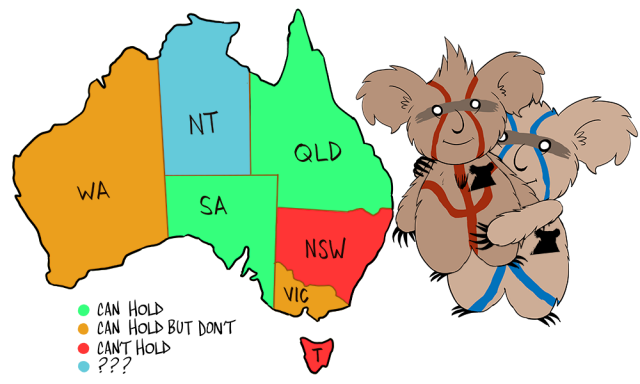
As Shakespeare might have said- "TO HOLD or NOT TO HOLD", that is the question!"
There is a difference between true koala parks THROUGHOUT AUSTRALIA that generate their income from the koala while allowing handling of koalas, versus the koala parks that do not. You would be surprised at the differences between parks across various states of Australia, and the reason for the differences will come as a shock to many. For example, many of these differences stem from fear, old-school culture and conservatism and sub-conscious behaviours and lack of education. For me, it is not surprising that the private wildlife parks and zoo are the ones that are willing to try something different and allow their guests to enjoy new experiences such as handling koalas!
In general, zoos and wildlife parks controlled by a government department, are the most conservative throughout Australia. They still hold on tightly to old-school behaviours. I think this started from conservationists of the past that created a culture of this control and protectionism. Over time, this created a culture that said, "hands off our koalas!" It started to emerge when hunters had total control of the amount of koala pelts they could collect; they were ungoverned at this time and it placed the koala on the brink of extinction. Australians hunted koalas for their fur from the late 1800's right up until the late-1920's. This practice was stopped because they were nearly wiped out. This set the culture of protectionism right-up to this very day. Adding to this is the fact that the koala conservationist resurfaced, and were at their strongest during the 1980s, again for the level of interest of the koala for photos! As the Australian koala came back from the shadows (due to so much interest from our Asian neighbours), the battle started again between the current koala conservationist and the new koala industry that had an interest to be up close and personal with the koala. And so, a new chapter of koala culture began.
The interest of overseas tourists and their passion for the koala is unrivalled by any other native Australian animal. The attention towards the koala in Queensland's really set things off! It was and still is the koala epi-centre of Australia. But this attraction also attracted a new version of conservationist who also wanted a slice of the big-pie! Soon, a tug-of-war developed, and the koala was bang in the middle of a turf war, where the conservationist was outraged by the handling of koalas, and secondly jealous of the huge windfall of koala money! So, they heavily campaigned for the rights of the koala, just like any labour union would to protect the worker! And to some degree, the koala conservationist did have some merit to their argument. Procedures were put in place to ensure that koala handling was kept to a maximum of around 20 minutes or so, per koala. And this is why some Australian wildlife parks had so many koalas! So, the practice continues, where koala photos were taken! In the height of the koala's popularity, the koala could draw over a thousand tourists from around the world per day, the biggest crowds came to the south-east of Queensland. This would generate tens, if not hundreds of millions of dollars per year. And, of course, the conservationist was also at its strongest in Queensland, fighting back, because they feared a repeat of the late 1920's, where koalas were nearly hunted to the brink of extinction. And for that reason, they campaigned hard and spread their message right around Australia for decades. If it happens once it can happen again. This type of protectionism was a result of the unknown of the future, and the strength that money brings to a limited few. Which again had good merit.
Below: This photo depicts the koala fur trade in approximately 1927.
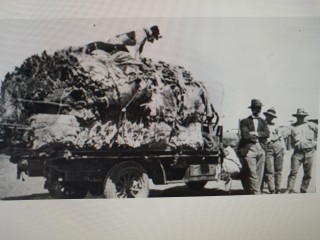
As the picture demonstrates, in the late 1920's, Australia had limited resources. Farmers and hunters were already working the land, and it was a simple transition for them to hunt something different and create an opportunity for themselves. This was basic human survival skills. Back in those days, life was tough, with limited opportunities to get ahead. In some ways, this is a form of entrepreneurship and creativity which at the beginning was expected by all!
The hunters didn't know how to manage themselves and manage the numbers, particularly as modern forms of communication and technology was very limited during this time. Back in those days, society did whatever they could do; killing for food as well as creating an income for their families; it was the same right across a range of native and domestic animals. What's different from THEN & NOW, is the level of ethics, balance and understanding that society has towards animals today. Our technology, communication and emotional intelligence has evolved.
But this shouldn't stop us moving forward and continuing to learn along the way. What's needed is that BALANCE LINE! A line of knowing what's right and what's not right, one side of support, on the other, the side of resistances. This helps us understand that balance of behaviour towards the animal and our knowledge. Learning our own balance of behaviour was much different back in the 1920's: the language and depth of emotional intelligence was not common in those days. But again, things were limited, and people did what they could to survive. The behaviour of life is always tough, it evolves through time, today's environment has changed. Sure, I'm glad that the conservationists stopped the fur trade, as the hunters were out of control! Like everyone, I'm happy they moved on to something else, but to hold on to this emotional guilt in today's environment is not appropriate. Taking photos and holding koalas is not the same as hunting for fur. The koala captivity management are well controlled and conscious of their behaviour as well as that of the koala. Holding koalas, now is a step forward in our evolution - if anything, we need to find ways to become closer to our native animals. Not all AUSTRALIANS WILL understand this, but this is a part of the balance and diversity that needs to be achieved today.
Diversity comes in different formats and we should have an open discussion to bring the two together for the longer long-term survival of the koala and other native animals. Because you don't know where the answers will come from unless diversity is part of the bigger picture. Even today, I still find when talking about koalas around Australia that there is a culture of suspicion. If you ask too many questions there is a high amount of insecurity. This is because of the disconnect of understanding of what's happening in other states and between wildlife parks in the same state.
Education and cultural behaviour training is virtually non-existent and there is a clear difference between the GOVERNMENT-run koala/wildlife parks, zoos and the PRIVATELY-OWNED wildlife parks/zoos. Now, smaller government-run koala parks are quick to defend their actions, saying in some cases, that privately-run wildlife parks or zoos are only allowing their guests to handle koalas for the money and income it draws. While at certain times, their own actions have no accountability and offend or spark an over-reaction from staff to their animal care. However, the focus should always be the pursuit of Balance and consistency. It goes both ways. What is comes down to is the fact that no one side has total control – the balance line shifts from time to time, and to me that's perfect! Then, add the elements of the conservationist who also wanted total control but who work in an open environment themselves causing again a huge lack of accountability.
The lack of true government support has pushed privately-owned zoos to think outside the box, which government-based zoos and wildlife parks have become frustrated in which way to go. Go too fast and they get criticized and go to slow it is also the same. So, the Private zoos are the first to try something different, which can be easy fodder from the government zoos! Whether they are right or wrong, at least they try in an industry sunk in FEAR! The same could be said for the conservation sector – it is all about controlling their message. This can limit progress and create confusion. Most importantly, it means things do not move forward at a pace that's enough to control mistakes. In the end, we are all held back by a range of emotions and debate, including jealousy. Again, if you look back at the case study of Cape Otway, you can learn what NOT to do.
Society must stay current and change and move to evolve with educational plans. Like anything, when you pursue a challenge, you become aware of your animals' capabilities, and koalas are very capable of being handled. When your vision is very clear in the micro and in the macro then you have a strong foundation of respect that can be built upon. Some smaller and large zoos don't seem to understand (as most don't understand the meaning of what's essential for a koala in captivity, the different components of whats routine and not routine), once those components are sort, then its about applying both husbandry with a coordinate effort with certain food groups, then the koala will feel much more secure. Many government and private-run zoos fail to understand that koala care requires more than simply supplying a primary food source and focus on keeping them alive. Getting closer to the koala with a hands-on approach makes it easier to fully understand the koala. A hands-off approach creates a certain amount of protectionism that's unwarranted, in regards to a captive state and the work of conservationist when everything they do, is from a distance. Has its draw-backs, such as creating certain work skills that's require, when managing koalas in the wide.
This is apparent in today's version of working with koalas, and within certain wildlife parks and zoos, who would rather create an atmosphere of disconnect when working (and not know it!), and staff unfortunately work in boxes, as the work itself is compartmentalized. They separate the culture of the work into groups, where today's senior koala keepers now create a different language from the work of today. Having long term knowledge where someone like myself has had the opportunity to see both side of the fence, receiving - good reliable information becomes rare.
I come across this type of workmenship all the time, where I have no time to hold back information, for me I enjoy bringing all keepers closer to the koala and explaining how staff can create awareness programs where they can see how they can learn to bring up their koalas' using certain tools of the trade to identify their koalas' strengths or weakness. This creates different types of environments and micro environments within their own enclosures. But of course, this would need to be part of a much larger program to keep it consistent. As I mentioned before, koalas like a certain amount of consistency in their local environment, so both sides of the dietary and husbandry programs must connect as one in order to see a different type of character in your koala. But again, I constantly see an unnecessary tug of war between staff which influences koala behaviour and subsequently, the industry.
Unfortunately, a certain amount of koala staff and society view making money from the koala as a negative and they fail to see the advantages that money can bring. In the right hands, this money can be the positive transfer of knowledge, which leads to a new form of infrastructure. But with the businesses structured as they are today, short term or overseas investors don't see that they are a part of the koala demise, as its seen in their eyes as an incremental behaviour. And this type of business behaviour maybe acceptable in a business sense, but it's not effective in the long term. It is an ideology that cripples our work knowledge, as it restricts our behaviour for the animal's perspective, to the investors perspective. Cash seems to fall to a small number of investors, which as a result, leaves the general staff inexperienced. If we can create a vision in which staff receive a better wage and ensure employment longevity, then this would have to be led by a number of smarter investors, which may come about by a smarter society.
Firstly, we need to identify all the different levels when working with large koala numbers. In both the captive sense and the conservation sense. This leads back to the Line of balance, for example, how we feed the koala knowing our society is continuing to grow and work while also giving consideration to mistakes, as we all move forward. Making mistakes a long the way, should be a dirty word, or seen in a negative light!
Is anyone, other than myself, searching for that Line of Balance? Why can't we as a society limit our ego (not totally remove the ego, as ego has a place in this world), but balance our obsession of the word "control". Everyone believes they have the answer, when really, they don't. This includes both the captive sector and the conservation sector. When the answers, is a piece of them all, stop judging everyone else in the pursuit of knowledge. Stepping back and increase our way in which we learn and investigate our understanding of where we can take our koalas and native animals into the future. Hopefully society will be excited about possible solutions.
In Western Australia, the culture is one of influential belief that holding a koala is bad. When I see this, I wonder how such fear has spread throughout this state.
Legally, in W.A the public can hold a koala if the park has the right infrastructure in place, and for one Koala park, in Kelmscott, called Cohunu Koala Park, they handle koalas on a daily bases for the public to really get close, whereas all other wildlife parks in W.A choose not to handle their koalas, which is fine, but if you ask them why they don't handle, you get a range of negative feedback! I think this belief goes back to the 80's when the koala conservationists were at their strongest, which is an easy way out, for CONTROL, which relates way back to the late 1800's hundreds to the early part of the 1900's hundreds. I think this belief started-up again either in NSW or Queensland, as the AKF (Australian Koala Foundation) at least to me were the loudest. Victoria was the same as W.A: you can hold a koala, but it's up to individual wildlife parks and zoos and their infrastructure. The only other states where you are definitely not allowed to hold a koala, unless you are trained and are a part of the zoological sector, is in New South Wales, and Tasmania.
If you compare all the other states to South Australia and Queensland koala parks, where you can hold a koala, they are the biggest and strongest koalas' parks in Australia, but the money generate doesn't extend far enough to the general staff and management, which is one part of the demise towards the Australian Koala. South Australia has one strong koala park called Cleland Wildlife Park, whereas Queensland has over 6 or 7 koala parks holding more than 50 koalas at any given time, (if you also included the koala hospitals they vary).
Queensland have the most amount of koala parks with the largest koala numbers in AUSTRALIA and around the world. Whereas koalas who over time are bred into this practice of being hold have no problems toward their captive environment. Even some koalas from the wild have a great temperament and could easy fit into this type of training and be handled by the public. This says a lot about the koala and their ability to adapt. By working closely with your koalas, you are developing close awareness of their behaviour and you can pick up their slight behavioural issues and changes, which is an asset for your staff, particularly in health prevention.
The next article: Article 24 is the conclusion to this theme, "what's in the word Conservation" and whether we as a society can get the balance right in this koala industry and the zoological institutions.
52 Articles, 4 themes 1 story