
The vast majority of the time, it proved extremely difficult to get an answer to the simple question, "How many koalas do you have?".
How many koalas do you have?
There was a range of responses and emotions attached to that simple question. Tasmania had the strongest response, followed by South Australia. There was no real hesitation or judgement in response to the question, they simply replied. These two states seemed to stand out for customer service!
In Western Australia, the receptionists had limited knowledge. When I asked how many koalas they had, the response was consistently below average; there was, however, an underlying tone of anger.
If you start asking about the process for handling koalas for photos, the conservative argument that parks shouldn't exploit koalas for money emerges. Only one wildlife park offers this service. Sadly, this culture still rears its head today in Western Australia and is a form of victimization that only holds back the industry.
Victoria's smaller wildlife parks were very engaging. In general, the smaller koala parks were better at providing information compared to their larger institutions (Zoos Victoria). This was because I didn't have to navigate as many channels before receiving customer service. The majority of the time, people with inquiries are asked to simply email their questions through but, for people like me who are trying to gain a better understanding of the institution and sense of the park by the way the receptionist engages with you, it's that receptionist role that can sell or destroy a business. The more information they know, the more likely it is you will decide to visit.
I find that the large organizations have much less information to give, mainly because of their own workable knowledge. Some – not all – medium to large institutions are so time constrained, not allowing staff enough time in their day to provide strong customer service. By slowing their pace of work they will deliver extended benefits to the public, building relationships and encouraging return visits. And that extra time would undeniably help support certain parts of their work, providing a bridge to their animals as well as to the visiting community.
For me, it was interesting to hear the reaction from each and individual wildlife -parks and compare them to larger zoological institutions, as I slowly range each one, from to state to state, it actually took longer than one weekend, I called over several weekends. By asking the one important, but Simple questions frequently became a big deal, with staff seeming to bicker amongst themselves and scrambling to find the right person to find the answers.
"How many koalas do you have?".
In some cases, I was questioned for asking this type of question. I came up with a story because I knew that if I told them the truth – who I was and that I was writing an article for koala numbers around Australia – 90% of the time I would have been referred to their management or simply hung up on. This is the culture of fear that exists in my industry, even today! I think the only state that wasn't worried was Tasmania.
In general, my experience calling around was to ring again when a particular staff member was in. It is clear that there is a lack of communication, or perhaps bad business practices. It can feel like walking on eggshells.
The underlying culture here in Australia among the staff is hesitation, with many people reluctant to go outside the normal practices and explore koala history in Australia. This cements the insecurities within the industry, which goes back to the conservationists who makes our industry uncomfortable.
We need to acknowledge that the old culture still resonates with many of the older patriots and staff members, who then pass this hesitation and insecurity onto the younger generation. The younger generation often can't explain why they behave the way they do; they can't explain their insecure koala culture because it is spread not only in the captive sector, but in the conservation sector, too. There has been a heated relationship between the two groups in the past. Yet although both sectors have slowed down their internal fighting, they continue their own battles internally by playing out the victim and hero roles. Unfortunately, this mistrust still exists today.
The koala is a natural resource that can be used in line with population growth. If we can just establish a platform where every industry, not just our own, can have the potential to grow, with commercial industries provided the same opportunity to grow alongside the koala and our native wildlife and vegetation, then we will see huge, positive results.
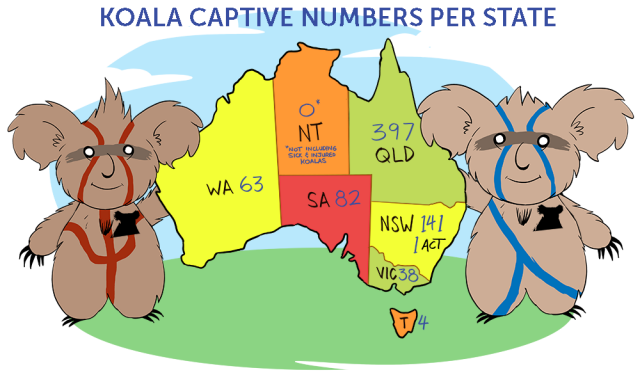
Below are the general numbers of koalas in captivity around Australia.
Queensland
Total Koalas: Around 397
Lone Pine: 120+
Currumbin Wildlife Sanctuary: 53
- DreamWorld Koalas: 50-60
- Paradise Country: Approx 30+
- Australian Zoo: 40+
- Australian Zoo Hospital: 30 to 130 depending on season and road injuries
- The Big Pineapple: 16
- Port Douglas Wildlife Habitat: 5
- Koala Gardens, Cairns: 20
- Hartley's Crocodile, Cairns: 20-25.
NSW
Total Koalas: Around 141
- Sydney Wildlife Zoo: 16-17
- Taronga Zoo: 22-25
- Dubbo Zoo: 10-12
- Symbio Wildlife Park: 5-8
- Reptile Park: 29
- Featherdale Park Blacktown: 30-40
- Pennant Hills: 4-5
- Fairfield City Farm: 1
- Blackbutt Newcastle: 4
- Sydney Safari Zoo: 0 (opening later this year).
South Australia
Total Koalas: Around 82
- Cleland Wildlife Park: 50-60
- Kangaroo Island Wildlife Park: 16-20
- Adelaide Zoo: 2 new koalas.
Western Australia
Total Koalas: Around 63
- Cohunu Kelmscott Koala Park: 15
- Caversham Wildlife Park: 30
- Yanchep National: 8
- Perth Zoo: 2-3
- Adventure World: 7
Victoria
Total Koalas: Around 38-41
The first 3 is Zoo Victoria, notice the low numbers across all 3 institutions, this shows a lack of interest and understanding from a government base body. They should have the highest right across the board and present themselves as a clear- point of differences. Whereas Ballarat Wildlife Park is in para with them. It's still very low compare to other major states of Australia.
- Healesville Sanctuary: 2-9
- Werribee Open Range Zoo: 3 or 4
- Melbourne Zoo: 2 or 3
- Ace Hi Ranch Wildlife: 0
- Ballarat Wildlife Park: 15
- Bimbimbie Wildlife Park: 0
- Halls GAP: 0
- Jirrahlinga Koala Wildlife: 5
- Phillip Island Wildlife Park: 4-5.
Tasmania
Total Koalas: Around 4-6
- Tasmania Zoo: 2
- Bonorong Wildlife Sanctuary: 3
- Nature World: 0
- Wings Wildlife Park: 1
- Zoo Doo: 0
- Trowana Wildlife Park: 0.
Northern territory
- No koalas
Canberra
- National Zoo and Aquarium: 2 (Matilda has a boyfriend now!).
A note on Canberra
Among of all the states in Australia, the ACT has the most restrictive access towards the koala. Staff members are restricted to handling the koala only once a week, and that's only for weighing. I think that the only other exceptions are for medical reasons, transporting and breeding.
Such restrictive regulations only show the lack of understanding in Canberra. This is a real shame! There is a true naivety towards the koala, which continues to intensify given that they never truly work with them. How do you learn about the koala unless you get closer to them? Humans only learn about a subject with close, intimate contact.
Yes, learning from a distance does provide some form of education, as seen from traditional conservation work. But it doesn't compare to the intensity of learning that comes from developing a connection, learning the different personality traits from one koala to the other, and seeing the differences from husbandry and dietary work, that only can be provided from a background of a commercial and commerce platform.
From Perth to Canberra, and right across Australia, there is one single word that tends to scare Australians when working with koalas. This word, which has become a hindrance in changing the knowledge and culture of the koala, is the word 'stress'. It is a word that is grossly overused and misrepresented.
When handling or capturing a koala, the word cry's OUT! don't stress them out! Be careful about going near a koala, you might stress them out! And if a koala flights back or become aggressive because they are being handled and a cry rings out, you're stressing him or her out! This isn't the case! Like anything or anyone, suddenly being handled either for the first time or being mishandled, they are simply reacting normally – they're pissed off. This is known as simply as micro-discomfort, it's not long lasting, and knowing the differences shows part of a larger picture into the, koala behaviour.
Working with an animal that isn't normally handled by a foreign entity is going to generate a reaction. This is normal. But critically, discomfort aroused by short-term interruptions doesn't leave long-term health affects because the experience is short term.
Knowing the opposite, only comes from experience- staff and researchers. That's what lacking for the long-term survival of the koala. Koalas can live quiet comfortably with roads and other society major infrastructure, it's a question of the landscape and the platform in which, we the society itself, demonstrates their understanding and knowledge to bring together all the elements and layers in a modern society,too truly understand the way of the future. Australians still has plenty of opportunity into the future to set-up such a platform, which I'm happy to inform you, in up and coming blog articles, under this theme VISION.
Our next Article: 43 Similarities of both koala industries.
52 articles 4 themes 1 story


