
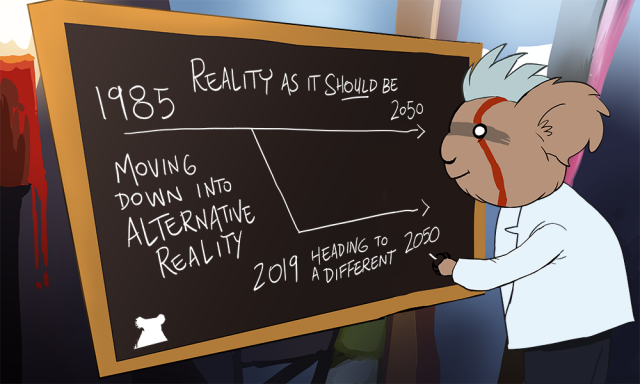
When did the Koala industry start veering off course?
Let's go back in time! This time, if we start with two major underlying themes, and if I use the same template as Dr Brown, we can see some incremental changes over the years.
Firstly, we need to change our way of thinking by removing the notion that our needs, as opposed to the koala's needs, come first. This will create flexibility and an increased ability to expand our minds to really focus on just how far we can go in order to unlock the full potential of the koala. This will have a flow-on affect, directly influencing our ability to innovate and create new approaches to presenting these remarkable animals in both captive and free range.
Their gradual decline is due to a number of factors, all of which I've written about in length throughout my blogging. Central is the behaviour of our blue-collar wildlife management – for some reason, we aren't getting traction. We can't convince the white-collar brigade of the missed opportunities that we have all had to change the storyline over the years.
A lot of excuses come from the increase in urbanisation, but also from our inability to tell a new and different story of the koala to the public and to our politicians. Funnily enough, it's because of urbanisation. Now we could use that to our advantage, but instead we use it as a roadblock, a barrier. The koala industry (from both camps) uses this hurdle as a form of victimisation instead of using it as a form of change.
My take on urbanisation is this – it's not going to stop, so why fight it?
I believe that we, in the koala industry, have taken all the steps and laid the foundation in place. But we're limited – we limit ourselves by our own imagination. Our way of thinking hits a brick wall. How can leaders and politicians help us if we don't know how to help ourselves? It's not the politician's fault if we don't give them a vision for the future. It will take time but, as I've outlined before, time itself is a resource and a valuable commodity.
Considering this, our industry must allow other industries to continue to grow, as they are worth much more than our own at the moment. The koala industry will have another moment in the sun. And the future? We will share it with other industries, however these industries need to be layered in the right position before we can get the koala back on track for their long-term survival. The image below is from Dr Brown in the movie Back to the Future 2. This is a GREAT MOVIE in terms of using the parts we need and learning from them if we chose to! The illustration inspires us to claw our way back to reality using small stepping-stones, ultimately working towards an industry that takes an open, innovative and agile approach to koala management!
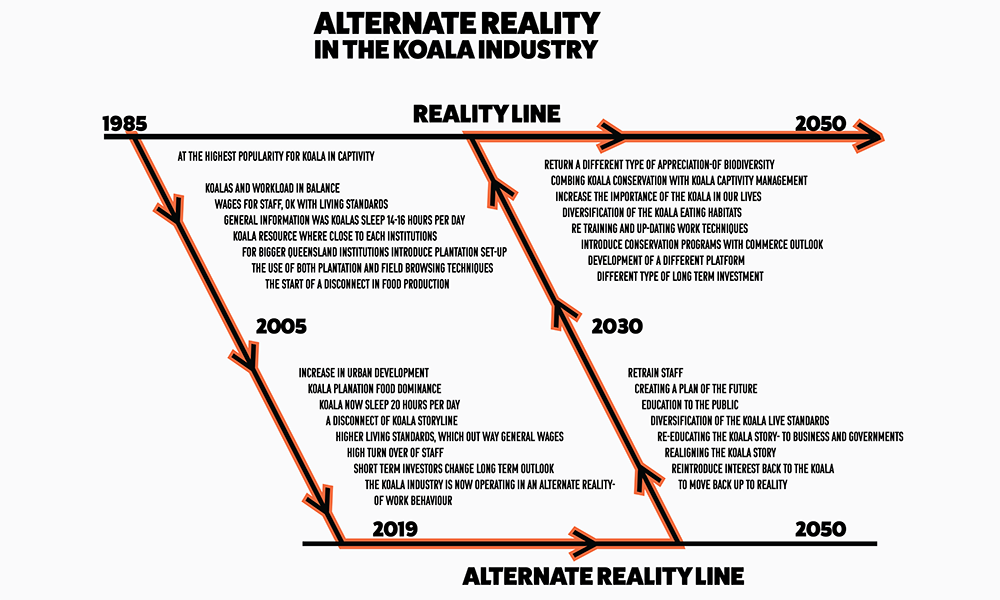
The timeline begins in 1985 at the height of the koala industry. At that time we were all on our own, with no support from any other industry. The business structure of the captive sector, with all the different types of wildlife parks and zoos had no oversight; there were no platforms that enabled individual koala businesses including the conservation sector and the koala hospitals to challenge each other under a watchful eye, such as an independent Federal watchdog.
As a result, we started to fight amongst ourselves, creating a divide in beliefs. We needed a platform to: (a) unite the two groups; and (b) enable competition to happen between the conservation and the captivity sectors; and (c) provide a forum for each to disagree under the banner of commerce, which would also operate under this Federal watchdog. (I am still yet to work that one out; it depends on the success of the first platform. But 1985 was the first step of our downturn. Although a popular industry, that popularity was smothered by negativity from the conservationist sector, a negativity that spread like wide fire!
Following the downward trend of the stepping-stones you can see our collapse into today's ALTERNATE REALITY OF 2019. For me, this is the vision and the steps we need to take in order for us to work our way upwards towards 2050. By that stage, our Australian population could be around the 50 million mark, I estimate.
Back to the Future
One of the critical steps to moving up is to understand the restrictive behaviour and knowledge we place on ourselves.
As an example – let's look at our koala. Our koala is basically a nomadic animal that moves during the night, yet humans see them during daytime. What type of message are we presenting when we put them on show during the day? They tend to rest and sleep between the hours of 10am to 4pm or 5pm, which is interspersed with short and intermittent bouts of activity.
At night, they are at their most active. Yet we tell a story, saying they are lethargic and lazy because their food is low in nutrients! WHAT A LOAD OF BULL-DONE!!!!!!
YES, THE FOOD IS LOW IN NUTRIENTS. AND YES, it is one of the major factors for their need to rest and sleep. But any human or animal that eats too much needs sleep/rest after a meal. But young koalas have that extra energy in reserves, as nature provides. It's our human way- for us to be active during the day, opposite of the koala. Combine that and the way the captive industry has shifted their feeding strategy- that further distance ourselves of their true potential.
But think logically – in the way human society lives, and our way of seeing their best form of presentation, we have design simple enclosures. These enclosures provide little (if any) noise protection from humans banging away at their enclosure walls or large groups of people walking past, on wooded beams, all the fact the koala need that CERTAINTY and security to look down on us not at eye level. Sure some koalas enjoy the company of people and get use to the noise and seeing humans at an eye level situation, but not all koalas enjoy this experience, we just assume that they are all the same, instead of design different types of enclosure, in order to see their true personality. And provide not one type of enclosure, but 3 or more types of enclosure designs. Majority of the enclosures persist of one design of 3 by 3 meters enclosure with 3 wooden tree Perches with each having 3 forks in which for the koala to sit in. That's been like that basically forever.
So, in captivity, they rest and sleep. However, I've never seen any research on the actual level or intensity of their sleep behaviours. I'm sure, just like humans, they have a range of different types of sleeping behaviours that range between light and heavy sleep, and rest time. So, let's not jump to any conclusions. Any new koala coming in from the wild with injuries wouldn't really understand the world of the captive koala, which has been conditioned to the human way of life.
It seems to me that having that quiet time is essential for the koala to move vast distances (the distance varies depending on age and sex). Rest equates to energy required, but in captivity everything seems limited/contacted to me these days compared to when I first started.
Any new koala finding itself in captivity, and with an injury that determines they can no longer survive in the wild, would find it hard to sleep. As a result, it has no choice but to adjust to the format that humans provide. These koalas would have to be forcibly conditioned, instead of ways to research their behaviour patterns to stay awake during the day, not really getting deep sleep, because of our inadvertent "staff members". This is because we humans are actively working around them, disrupting their sleep patterns naturally inherent in the wild. Its not always wide spread- it's more of understanding and considering how the shoe fits on the other side, and its these little things that are missing from the pass.
We must acknowledge this before we start working our way up the ladder of REALITY. Again, I'm not saying this is bad. Koalas, like humans, learned to adapt. This is part of the process we need to implement – identifying who/what can adapt, and who/what can't – and we work with that! This falls in the category of husbandry work.
We then change our focus to their dietary concerns and the way we feed them. We respond to our knowledge that, during autumn, their diet starts to change before the high toxicity levels occur during the following season in winter. This means that not only is their food more toxic for three months during the period of winter, but also that zoos and some wildlife parks need to be conscious during this period of potential increase in certainly individuals koalas stress levels. The captive sector and unfortunately free-range koalas are affected in a different way, but the captive sector inadvertently do this by limiting their nutritional variety by collecting food from limited locations (anywhere from a singular location to three or four). On top of this, they reuse these same locations over and over again on a weekly basis. That's bad dietary Practices!
Now this may not seem problematic to you, but recognize that the koala has its own built-in behaviour that instinctively allows it to know the level of toxicity simply by smelling each leaf before they eat it. So imagine a koala, let's say in the third year of its plantation food cycle. Or imagine a wildlife park sourcing food from the same area during the winter period as they have from the previous two years before that. The koalas are conditioned to eat our way. Some can coup and some can endure, and some don't. This does have negative behavioural and health issues that follow, but never recognize as a secondary source of sickness. Koala's can oversleep and koala can become depress!
This is vastly different to feeding koala from the field, known at the beginning of their training as cutters, these are cutters that work outside of a plantation source food, where the only limitation is they knowledge and experience working out on the streets in the fields of the local area. Field experts, such as I, ARE MORE KNOWN as Dietary Specializes who strategically source food from an wide range of areas that always differ from one year to the next. This is because fieldwork allows you to follow a certain food pattern – that the environment teaches and gives you on any given day, month, season and year, so you follow that logic, rather than you bending so much of nature- that you lose or site and since of nature itself. And that's the difference! Koalas are known to live longer in captivity then in the wild by 2 or 3 years in general sometime even longer, but even that needs balancing in order of that to happen comfortably.
The koala captive industry itself never moved forward, particularly in terms of real research between us working with koalas and the real relationship on both of our behavioural levels, the captive industry gets it wrong 60% percent of the time, mainly due to a high rate of turnover of experience staff, koala are easy to manage when you know how, and that's when the right work ethic is apply and standards are maintained, you would find that koala's can easy co-exists with us much like the humble dog and cat. That's how close we can live with them.
This is actually why handling koalas, via the act of photos, helped us understand their behaviour. It could have been the first step of many, moving forward- so called – "the beginning of understanding them on a different level". The conservationists were horrified, mainly due to their lack of handling and experience with different koala personalities that they never seen themselves, the captive industry had that underlining theme of commerce which brought that purpose. Conversely, at least koalas understood there was a purpose and routine! Which majority of them were happy, you needed that wide ranging experience to work with them closely, with different daily experiences, which gave you a better judgment, from one personality to the next, and if you had that space and time and budget you could cater for all personalities. And this is where conservationists, who works with them from distance, believing that leaving koalas totally alone would be the biggest form of success, failed to consider the benefits from handling. This new relationship scares them. When it's done correctly and consistently, you see behaviour like ours.
You start to see another dimension to them; that they are more than a bundle of fur! Everything in life needs a purpose, even koalas. Some are happy to be part of the photos or presentation. Being surround by humans doesn't bother them; they can adapt well. But it is up to us to see any downfall to this experience. New ways will always be questioned, as they should be. I'm not always against the koala conservationist, but the search for more and more answers and experiences creates a genuine depth of knowledge on a conscious level. This is a form of education that's never really been expressed properly in both sector the captivity and conservation industry.
Why? I believe it's because the earlier koala conservationists created a strong scare campaign. As a result we, too, became victims within our own community. We became too afraid to express our professional opinion. But once you see another layer of koala behaviour stripped back, you can see untapped potential. This potential will lead us to new discoveries and a whole new world for them.
This is scary for most because we have a historical understanding and tradition of viewing koalas in a single dimension. For some reason our general psyche doesn't allow for us to see them in two or three dimensions. This research/ work whatever you wanted to call it! is required to diversifying their living understandings, which brings an increase chance of limiting their extinction by 2050.
Our next Article: 40a Sleepy Versus Active
52 articles 4 themes 1 story www.koalaretreat.com