
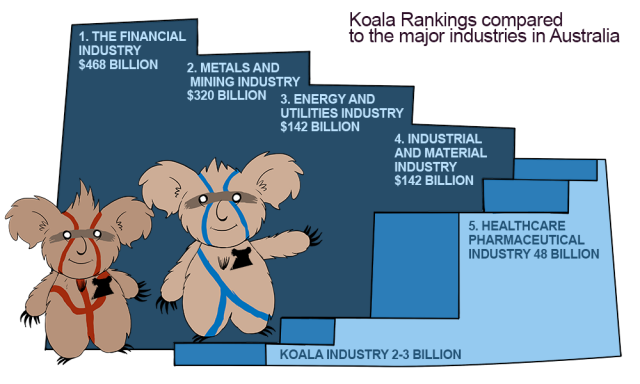
The koala industry ranking rates the koala industry as a whole, meaning both, the captivity and the conservation sector, compared to other industries who have evolved over time, including finding and sourcing the best people for the job.The koala industry hasn't had the mentality to compete with other industry. Instead, "It's our way or the highway!"
The koala industry does not have a culture of starting small and partnering with other industries. It does not support other industries before supporting itself, which is how volunteers for example find their way in the first place. If the koala industry had a culture of starting small and partnering with other industries, it would be able to move up the ladder of industries.
The best way forward for the koala industry is to align itself with all levels of governments on both sides of the divide. It's in the interest of both major political power-houses, if not all political parties, to find a new way forward.
The Australian population is growing. The trick is to find the Rubik's Cube, where all the systems within all industries have an equal share, to maintain the fast-paced environment and living standards that our Society expects. But there appears to be no one in this growing society who is brings koala conservation into the equation. Koala conservation is as something for outer city districts to sorts out, instead of it being seen as something that should be taken into account when designing our cities of the future.
Politicians are not well-informed. They need to know that koalas can live quite comfortably and longer in an artificial landscape, but only if they are properly supported by outer regions and districts. In addition, it is essential that koala refuge centers and zoos are governed and run by experienced staff who know when to add good stress over bad stress, to keep their lives full activity and purpose.
This is in line with human society and represents the orchestrated way in which society is ultimately governed, which is by commerce. The koala conservation industry is no different. Work under the banner of the koala captivity industry is work of the past and works well only when combined with the way we work, live, how we spend our spare time and how we improve our environment - while still maintaining our unique Australian culture, which is a part of our planet.
The koala industry can't do it alone. In order to climb the ladder of industries, we need to partner up with other industries. We have to find our slot and wriggle and push our way into the ever-evolving economy. In the koala industry, we have to first support the strongest industries by showing them the value of partnering up with us. This is necessary to be able to support the koala in the long term, before being able to stand on our own.
I was wondering what the Top 5 industries in Australia were, so I googled it, and here they are - the five major industries and their earnings :
Key Industries in Australia
1. Financial industry: $468 billion
2. Metals and Mining Industry: $320 billion
3. Energy and Utilities Industry: $155 billion
4. Industrial and Material Industry: $142 billion
5. Healthcare and Pharmaceutical Industry: $48 billion
The koala industry is way down the list at $2-3 billion.
I believe the in-fighting amongst ourselves, as well as our industry's fragmented vision, is the real reason we can't move forward and upward. The services industry is worth around $43.6 billion. The koala industry is part of this services industry, as it falls under the tourism sector. But for some reason, the koala industry seems to be unable to move past the 3-billion-dollar mark. When the popularity of the koala worldwide is much higher than the figure for the koala industry, why can't we get to a higher level?
Koala Industry
Koala Industry: $2-3 billion
Whether some of this information is right or wrong, it still begs the question how the koala industry can fit into the Rubik's Cube of the Australian commerce? This should be the ultimate aim of koala conservation. As a quick search on the internet points out: We still have a long way to go!
Unfortunately, the koala profession is one of the lowest paying professions, equaling the child care industry. Both industries compete with other major industries, and they are at the bottom of the list. It's a big task, even to merely think about pushing up and above another industry, let alone trying to get into the Top Five.
It's ironic, as the future lies with today's children. Australian mothers and fathers aren't being properly supported today. Our brains map danger and insecurity, which is not good for our psyche.
[1] Note: I undertook this Google search some time ago, ie, the figures may have changed in the meantime. It is not of importance which industry is number 1 or 5. The point I'm trying to make is to show the climb the Koala industry must make in order to be taken seriously.
If we as a society don't implement direct action that supports the growth of our future generations, then, eventually, the Australian taxpayer will have to pay for the lack of emotional intelligence and psychological damage in the community. The right education system needs to be put in place. That includes supporting single parents and understanding their emotions - that they are no different to anyone else.
These are all incremental ways to support us as a society of the future. And it follows on to our wildlife and koalas, as the level of ecology that supports their lives is based on the level of psychology that supports our lives. It's the basis that caters for all forms of life on this planet. But to get back on track - sorry, I went off trying to save the world - the koala can play a role, as well as the rest of the wildlife sector, and there is a way forward.
We will only move forward if we create a plan for the future and find ways to support other industries first and take the focus off us and instead onto Australian families directly and indirectly. We need to give stressed-out parents tools to cope when raising a family in an unforgiving environment as is life of today. An example of such a tool is the introduction of positive behavior training based on techniques used in our industry.
If we can understand the koala's behavior, personality differences, temperament and dietary intake (as they, too, have likes and dislikes), then just like young kids being difficult when eating, we can offer families behavior training within the families themselves.Techniques that the zoological community uses can also be used to reinforce positive behavior in children.
This type of merger between zoological industry and family issues, which could be governed under psychology, could also follow on to other industries, such as the housing, construction, education and technology industry - and come full circle as we are now tapping into the energy industry.
Other ways the koala industry could provide an immediate service to right now is the housing industry. Building houses of tomorrow will add the right type of education. The housing industry - if planned correctly – can be the industry for the koala industry! Working together and trying something different by combining our knowledge and resources with the housing industry could close the gap that's separated us for decades. A combination with the transport industry could then easily follow.
Finding new commercial partnerships and programs will involve the koala and show a different architectural mindset - combining new housing design with the environment in ways that stimulate young minds.
This will also introduce families to a new way of seeing the world and seeing their own behavior in a positive light: It will show families what the distractions are from making important decisions for a family's needs and open our eyes to what a fast-paced life it actually is. It's important to raise the children in healthy environment, surrounded by parents who are themselves emotionally supported by the society that surrounds them. Knowing the village, and being supported by it, can take the weight off parents. It will give their kids the tools to understand how the world is connected in terms of social history and geology - the science and layers of all living things.
Young minds have an inbuilt curiosity mechanism about the connection between the way they live and their relationship with animals. So many kids at a young age "want to become a vet", vet nurse or zoo keeper. They love animals, and parents encourage this behavior, sometimes unconsciously, because they want their kids to have a positive experience by having domestic pets living with the family. This is a conscious or subconscious repeat of their own experience from childhood. And so, it continues down generations.
It would be no different for parents who adopt a native animal instead for their children, as the children's experience is the same. At a young age, kids are so captivated by different living creatures that eat and sleep like them, have similar behavior patterns, but instead of having two legs, they have four legs. Kids innocently and simply want to know more. They want to know what the relationship is between them and what they are seeing and experiencing. It's the start of a survival mechanism.
If we start this process at a young age, create a smart society today, in terms of social behavior and emotional intelligence, it will save the Australian economically literally tens of billions of dollars, as these kids will grow into strong emotional beings. This is my understanding of what it's going to take - to evolve the koala story to be a-part of our future society, taking the pressure off governments, by providing a new service to the Australian people, by rediscovering the Australian koala and the native animals in general.
The koala industry already has a baseline and a relationship with Australian people and overseas tourists. We can innovate this industry by combing the koala with child care education in an environment that elevates the koala to a higher status which can compete with other major industries here in Australia.
In my next article, "Koala Industry Ranking - Part 2", I will talk about tourism and the importance the koala has in the tourism industry, but also about how tourism isn't the magic bullet and that it also lies with the Australian people to contribute.
Our next Article is "Koala Industry Ranking – Part 2".
52 articles 4 themes 1 story - www.koalaretreat.com