
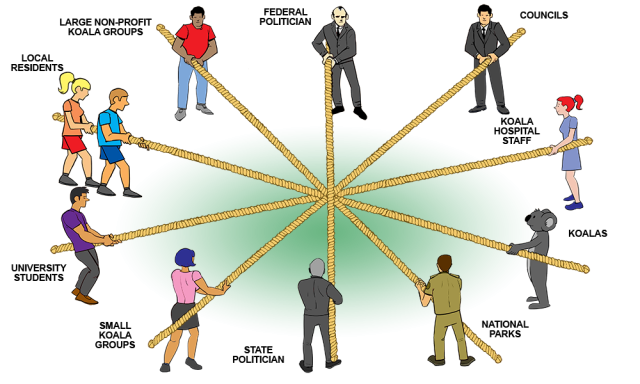
Planning for the future: Thinking outside the box!
This approach allows openings for a myriad of excuses. Our current system does nothing to close this gap. The blame largely lies with the larger groups of koala conservationists, though some parts of the community take advantage of this weakness too. Currently, the only vision and current form of seeing successes is in installing radio trackers. But these trackers only show movement, not inbreeding or fighting for one's territory. What is truly required constant field-work every day to find out who's entering who's home-range. This is the work of koala habitat consultants, like Lyn Bowden for the Campbelltown Koalas along Georges Rive, article 15.
Working in an open environment gives non-profit groups a window of opportunity to ignore their duty of care. Mainly due to the expense of hiring people such as Lyn. Added to that, you have superannuation, workers' compensation, and insurance to cover. And large koala conservationists just aren't willing to go this far; the amount of work involved will just deplete their donor funds. This coupled with the lack of vision to create an income from koalas themselves is where the problem lies. When something does go wrong (in the koala sector), government, councils and smaller community groups will scratch their heads and sit on their butts while the death toll continues to rise.
An example of this was in Campbelltown, where Lyn showed the level of knowledge that can be gained with distance and perspective. Non-profit groups should be encouraging more communication between each koala group. Currently, there is no system for this to occur in Sydney.
The koala groups across Sydney are all fragmented and divergent. How do receive support if they are not willing to communicate and if there is no shared vision or authority? In Lyn's case, she didn't ask for help - she just went and taught herself, with the support of the professional, Rob Close! Without internal personal vision, then there is no external vision - it's as simple as that! Lyn was simply a damn hard worker. I can relate to this, as I made a conscious decision to travel overseas to further my own knowledge and to understand how koalas were treated as an exotic animal. This type of behaviour comes from within, with no real external causes.
The gap that exists is evidently within the non-profit sector, at a local level. They, like Lyn, develop a different set of skills compared to the skills developed from working with koalas in the captive sector. Koala conservationists are limited by the fact that they follow koalas using radio trackers. They try to understand their personalities and characteristics by their movement and habitat. But oftentimes, this is not enough. Finding a koala in a certain tree doesn't mean that they eat from that tree. They might be sitting in it for comfort, or they were chased by a predator on the ground, or for any number of reasons.
Conservation groups are limited and so is the captivity sector. To achieve success, we need to bridge both sectors, and create opportunities for them to come together and fill in the gaps. This would only work with a long-term vision that would require the placement of a large group of koalas to a specific area which can be agreed upon by both groups. Describing each responsibilities and area of terrain, such as setting this business structure up like a franchise where each section is divided up into sections for one group to manage while others may do things slightly different. It's commerce that will win out, as completion should allow the strong to reach their true potential.
This format would give these groups' mediator's a certain amount of control, particularly around the commercial structure, which is vital in ensuring that staff are paid and the business is sustainable.
Furthermore, a commercial system creates a challenge, and can often inspire competition and high work standards. This program could ensure a high level of education, training, ethics and work standards are employed and be assessed in line with tourism in Australia as well as the impact and involvement of local community.
The importance, of using both groups' techniques cannot be understated. Both industries can play a role in creating a brand-new industry. Historically, the problem with non-profit groups such as the Australian Koala Foundation was that they wanted to dominate other industries including the housing industry, and this has boxed them in. They are limited by their focus on public appearances and rarely tackle the important and difficult issues such as working on their own backyard before trying to stamp their authority all around Australia. They only in recent events have seem to select their projects closer to home, as time itself have worn them down to size, and to be pushing to look a certain way, but not sure this means they will or won't embrace out-of-the-box ideas. Because of the old-school guard a time where the 80's was about excess, power suits and ego's.
Below is a graph that shows where we are in terms of Koala Conservation, where both Black Bars is in the Red.
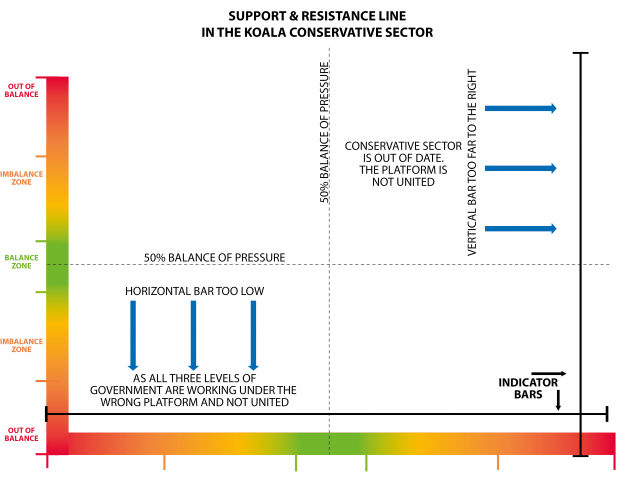
The BLACK - BAR itself, is moves up and down in the Horizontal chart, and side to side for the Vertical chart, which is measure by the colour scheme on one side, in a simple set-up of
Green - for good and stable
Orange - for imbalance warning – needs to be discuss-and have open dialogue
Orange-Red - warnings signs to the point of no-return, action is needed
Red – Reconstruction is needed start again. Start from scratch, blank canvas bulldoze down your infrastructure in terms of physical and mental, including staff.
If you follow and read last 2-week's blogs, and continue to read the next seven blogs, you will have a better understanding of the formula and be able to implement it into your own life and business.
This approach has the potential to create a strategy to pave a positive path to the future and trigger important conversations.
Our next Article is talking about the change in Social Enterprise in the conservation sector, for one koala hospital.
52 articles 4 themes 1 story www.koalaretreat.com


