
For me, I've mastered my profession without a doubt; supporting koalas in large numbers in the captive sector is my specialty. The role has many layers, dimensions and pressures. This role is unlike that of a conservationist, who works in an open environment that is separate from the captive sector with very different responsibilities.
The captive sector's set-up is confined to a set space and, therefore, has a higher amount of concentrated responsibility. Issues must be faced head-on and they are impossible to avoid. Captive sector staff have a different set-of skills, which now are losing the battle to a higher turnover of staff, low wages and short-term culture. Like building a house, you need to understand the right layers and have a strong strategy in place to support hundreds of koalas. In the captivity sector, there is no hiding when a death occurs, especially with the frequency of them across a short space of time. In the conservation sector, they have more time and space to deal with their mistakes and any death rates can also spin off in so many directions. However, both sectors are equal in terms of their own long-term vision. It's a question of 'how do we get there?' In the conservation sector, such an open environment allows an increase of negative elements to enter into their working environment. While a closed environment highlights and accentuates those negative elements so there is no room for escapes to happen.
Unfortunately, with short term culture entering the captivity sector of today, keepers are trained to merely clean and feed, instead of embracing the culture of the past in which every day training was also a form of detective work. When a series of illness or negative behaviour was detected, that was immediately picked-up by senior staff in specialist fields of their animal species. The culture BACK THEN was to identify layers of behaviour from themselves or other staff members that were contributing to a certain behaviour- be it positive or negative.
Conservationist Sector
They work in an open environment where there is a higher percentage of success and failure (which is not necessarily their fault). What they are at fault for is not coming up with new ideas to address the tension and overcome ongoing problems.
In general, as there is not enough of paid work or research investment for conservationists (they too struggle with today's world where investors put their needs before the needs of our environment). In today's environment, a more verbal advocacy is happening for a greener world and more creative solutions to damaging behaviour patterns. Hopefully, this will make a long-term investment a much more attractive option, rather than the short-term dominance structures that exist today. However, both sectors are equal in terms of their own problems and situations. They both aren't happy with the state of the koala being in its current population status and the outlook for the species as it stands today (which is vulnerable/threatened). In South Australia, they are classified as rare, in Western Australia non-existent, and it was only in Queensland back in 1992 that the Act has determined that the koala was classed as Common. But, a lot has changed since 1992!
Horizontal and Vertical Pressures
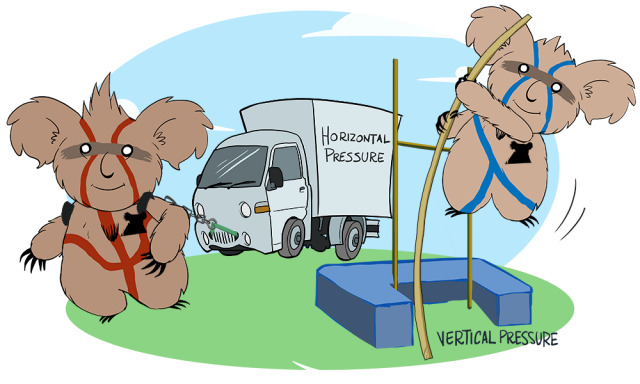
The koala fate is determined by our actions and how we manage ourselves when moving forward. The pressure we place on ourselves in a professional and personal will dictate their future. I've come up with two lines of pressure to discuss:
1. The Horizontal pressure line
2. The Vertical pressure line.
Horizontal Pressures
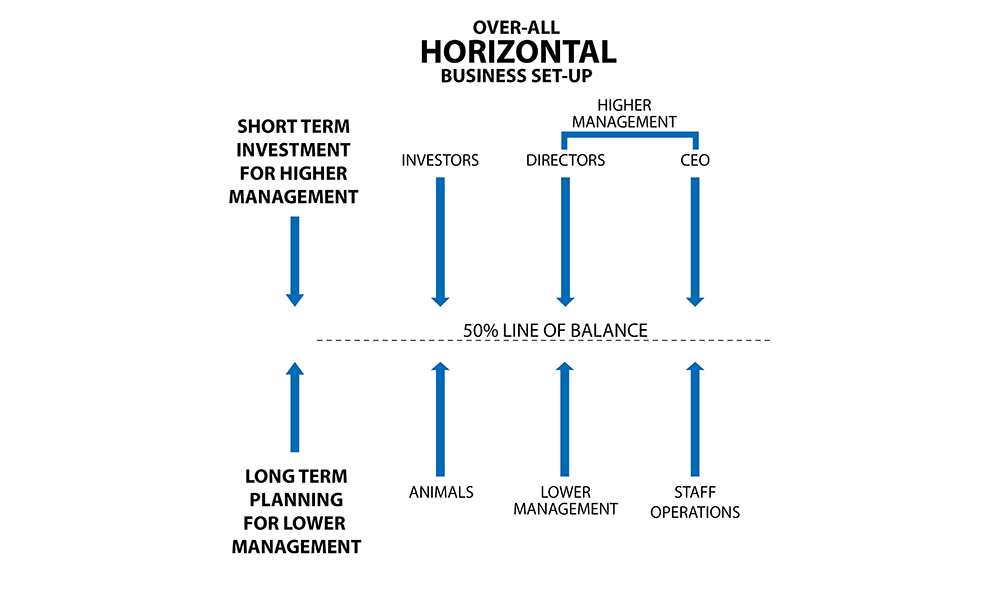
The Horizontal (as mentioned in the previous article) that is the support and resistance line. The horizontal line has Up and Down pressures, coming from outside pressures as well as within. For example, for koalas and the overall zoological industry, pressure is coming from the upper white-collar management of a zoo or businesses where they are trained and educated to follow numbers on a spread or balance sheet.
These people are limited just like people experienced in the field who need money and income to support their work are limited. Both have no idea of each other's importance as there's only a certain amount of time in a day, and a lack of willingness to learn the importance of each other pressures. This behaviour is apparent in both conservation and captive environments. In the captive sector, lower management are trying to save money by thinking in the long term, but depending what business structure you fall under, most large zoological business structures sometimes can see only in the short term, by seeking short-term investors. This imbalance of higher management and lower management has been discussed for many years, AND IS A PART OF THE ZOOLOGICAL CULTURE, but frustrations were never openly expressed in a public forum.
I'm trying to break down all the barriers involved and come-up with a solution in which investors will become attractive with a long-term approach, rather than short-term. Understanding the types of pressures within the lower ranks as well as the labour involved will hopefully solve some issues amongst the lower management and improve understanding while enabling transparency and maintaining and constantly improving standards right across koala husbandry.
So below is a visual aid, to show how things are set-up currently!
Vertical Pressures
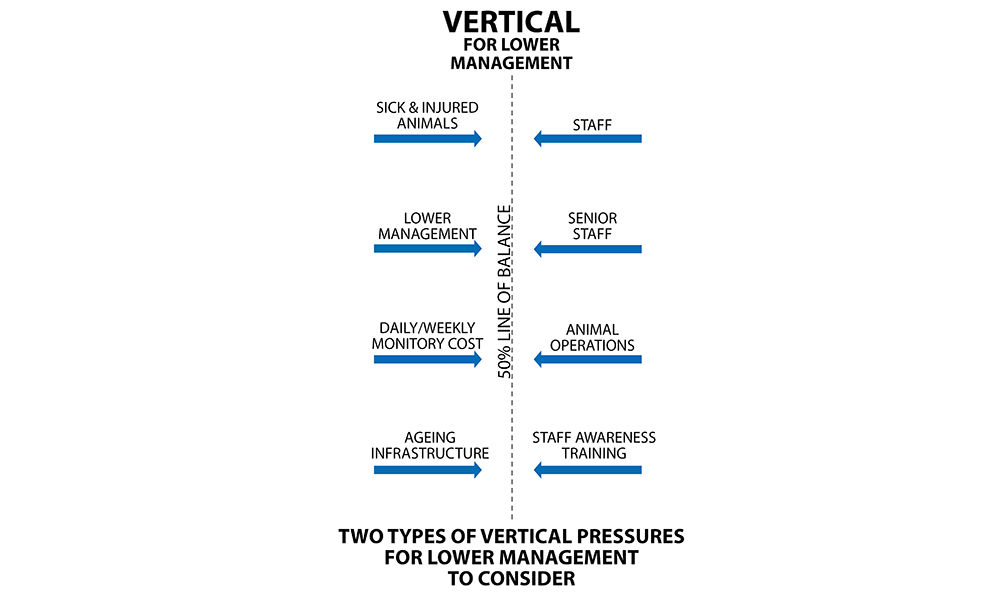
The role of the Vertical Pressure is to try and identify more of the pressure coming within the duties of lower management. There are two versions of the Vertical lines. The first is from an OPERATIONAL point of view and the second is from the staff PERSONNEL point of view, (of temperament. personality, and experience), which I will discuss in the next couple of blogs. I've identified this vertical pressure coming from side to side pressures and these are below the higher management level where I'm sure they have the same two vertical pressure lines. This can be universal and is apparent in all business structures in the captive and conservation sectors. This is the tug of war between different factions as they all work toward their own interests under one umbrella. A lot of the time, it just comes down to the amount of experience and how to deal with all types of pressures in management, as their work 50% percent of the time is just managing their staff to get along with each other. Such staff are generally either too young or too ignorant to see how they respond to pressure. Young staff are still finding themselves and finding where they belong in such a difficult world. Not all are compatible with this type of workplace, and they are doing themselves a disservice by staying and coming to work with no sense of purpose and no alignment with the business culture or structure. Then, certain staff members may act irrationally and create an environment where staff push and shove amongst themselves forming smaller groups of discord and disharmony. This usually is a result of higher management not supporting staff concerns or ideas. Staff may be receiving mixed messages from lower to higher management. Only a strong working platform will allow for a steady set of behaviours and language throughout the staff and management. This takes a clear understanding of where the business is going that's in line with the high-profile animals such as the koala. This will deliver a huge windfall for the business and the animal, which will follow onto the community by raising the income stream, creating more jobs, more ideas and more design infrastructure into the future.
To achieve this, we must begin viewing the koala in a very different light. We need to stop this trench warfare between the captive industry and the and conservation sectors and learn to work together, as both sectors have their weaknesses and strengths. This here is a form of support and resistance, and if it doesn't get resolved, then it can paralyse the industry and the entire Australian community, as well as our confidence to move forward and innovate.
Next Article: This article is about understanding the break-down of the Horizontal lines, in a way to move forward in the koala industry
52 articles 4 themes 1 story


