
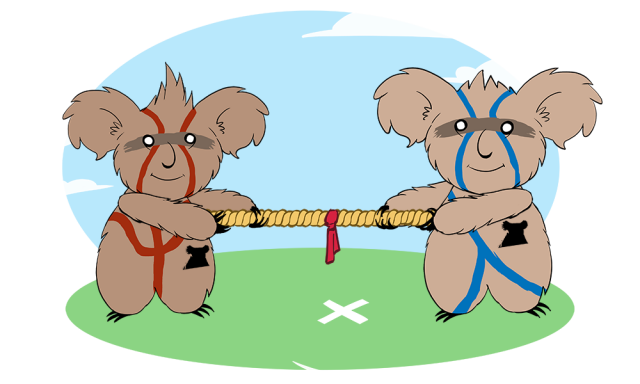
Sub theme: Support & Resistance Pressure lines
These two words are not necessarily in direct opposition with one another, they can, oftentimes, complement one another.
This is in terms of duties that involve koala husbandry. If you wanted to add more animals (meaning going big) then this means more expenses, more staff, more land, and generally more of everything. This can create ethical dilemmas too, as there is higher management costs and greater negative work patterns which are already prevalent in the industry.
YOU NEED to keep BEST PRACTICES close to your side. More of anything is BIG, which is close in the company of BEST. These two WORDS are CLOSERLY RELATED. They are like a married couple, or a brother and sister. You can view them like YING and YAN. They need to be side by side in everything this industry does. So, having more koalas on your premises requires best people, best practices and the best long-term requirements (especially if we are talking koalas).
In this industry, to comfortably feed a large group of koalas you need great field knowledge with expert identification skills in determining tree species, great local knowledge (when and where to source), and then develop great farming experience in terms of establishing a koala food plantation, as back soucre from your field browsing.
In the koala industry, to get the best out of your tree planting investment you will need to wait until the tree hits a certain size (in height and girth). In Sydney, for example, you would consider several factors, such as, climate, soil, rainfall, tree species, local pest and the propagation of your tree saplings. All these factors come into play as you could be waiting anywhere from 4 to 7 years before your first harvest. Some tree species, which naturally are slow-growing can take even longer if they are placed in the wrong soil type. So, in those first years you become a protector from everything - drought, bush fires, disease, vandalism - and because this is taking place in a farm setting, you must also worry about livestock and introduced species such as rabbits.
Plantations should only provide a back-up system to field work, as the koala is a nomadic animal. Koalas prefer to move around from region to region, so making up a diet with several different soil characteristics with between 20 to 30 different tree species was once the norm. Today, however, is different. Somehow, with high staff turnover (particularly in high and middle management) the norm today for zoological institutions is to source their koala food exclusively from plantations and from only one location. This still exists today, where the bigger zoological institutions with large groups of koala's source food from 2, or at best, 3 locations, with around 15 different tree species.
The koala's way of eating has even unconsciously changed, and today's zookeepers are unaware of the changes taking place over the decades. The way that we source their food has dramatically changed which has led to keepers now giving "koala talks" to the public. In these talks, they say that koala sleep for approximately 20 hours per-day. Whereas, 15-20 years ago, the young koala keepers were saying that koalas slept between 14-15 hours per day. Where did that extra 5 hours come from?
The reason for this is that they are under-nourished. There is an art to the koala diet and enrichment. In the past, zoo's and wildlife parks had room to source a wider variety of food daily. But today's environment has changed, and plantation food dominates the koala diet, making most of the captive koala population tired, lethargic, and in some cases, depressed. If koalas are so sensitive to the chemical composition of the leaves changing through the four seasons, why would you think they would enjoy eating the same thing repeatedly? Today, the priority seems to be given to window-dressing. We don't have long-term infrastructure to support a growing group of koalas. Many zoo's and wildlife around Australia are made up of inexperienced volunteers and staff who have limited knowledge compared with the staff of 10 or 15 years ago.
To ensure that both BIG and BEST are working together, long term planning is still essential. In this current climate, it is more important than ever before to hold onto CERTAIN tradition AND LET GO OF OTHERS, WHEN sourcing koala food in the field, because the skills required will benefit the koala industry in the long term, rather than this short term-cost saving measure of relying heavily on plantation-sourced food. Again its balancing act, but how does one know where the line of balance is, when we have so many different layers facing us today! Sure, it places pressure on zoological institutions, there pressure no matter which decision you make, but -knowing the differences is the key! this type of pressure-will win out, in the long term rather than this short-term pressure of today and today's environment the industry has created. Relying on plantation food has lasting negative consequences on the koala and the industry. At the time, middle management just didn't know or care because they were protecting their own interests and spun stories to reflect that. The Government-run zoological institutions decided to go down that route decades ago, cutting cost after cost, all so middle management can impress higher management to achieve better work titles or positions. Then they leave the industry completely, just to reach the same level of work title, but in a different industry, leaving behind the mess they created. Government zoo's do have an influence over other smaller and mid-range zoos but their processes and practices aren't always right.
The work environment places pressure on the individual, but for different reasons from the past, and identifying the changes is a skill on its own.
Times have changed and there is a different type of transparency and accountability involved now. The responsibilities in which young keepers working to are so much smaller and concentrated than the responsibilities of the past. Working styles and duties have become more robotic and there is little to no chance of people working things out for themselves. I'm sure it's not in every case but it is certainly apparent. Similar to the way the zoos feed their koalas - it's getting worst not better. Keepers today aren't taught certain work skills, which means that they aren't aware of the behavioural problems of koalas today because they didn't see them in the past. They cannot tell the signs of a koala in distress, or a sick koala. There is also no training in prevention, which is another core skill that is missing from today's staff capability. The relationship between best and big is out the door. The koala industry in BOTH the captive and conservation sector has become complacent. They are simply pumping out what's expected, (short term education and vision in line with the investors) which is not what's needed. While the conservation sector is losing the battle to save koala habitat, the captive sector is stuck in its traditional and conservative modus operandi and is reluctant (and unwilling) to push boundaries and innovate.
Quality of staff surrounding koala conservation is inadequate, needing more hands-on and skills-based training and field educational training, rather than a heavy reliance on academia alone, and so-called koala experts comment from a distance. Academics have helped in the past, and I'm sure they will into the future, but we need to level the playing field by introducing more measures to attract trainers on the ground. But in today's digital age, the goals have shifted, and for some reason the conservation groups are also slow to react.
The traditional sets of frameworks and guidelines to attract youth in the past in the conservation training sector has become irrelevant today. The youth of today are different, and the industry itself needs to change in all areas of operations.
In terms of education, half of the Australian population is now asking for more tradies, in all forms of the blue-collar workforce. Teenagers learn best by learn by taking a hands-on approach, where they are encouraged by their own free will to pick up literacy and numeracy skills while working on the job. Sure, the basic teaching model is there to provide the foundational requirements to the masses, but society itself, has change, and so must we, by re-educating ourselves in a new area of this digital age. For teenagers of today, it is equally important for them to find a sense of belonging and identity as it is for them to select school subjects. Allowing them to experiment and try a hands-on occupation is much more productive then pushing them to just sit behind a desk and telling them that this is their only option. Having a hands-on working environment can help individuals pick up necessary life skills and provide countless learning opportunities.
There are two fronts when talking about creating a balance between ethics and business when working with koalas and our native animals. Business is the lifeline of human existence; it gives us a financial purpose and a livelihood. However, we need to formulate a program that can combine all unique individual circumstances and situations around Australia.
To find a formula, we need to find and break down our own strengths and weaknesses and explore the industries and positions that we can thrive in.
My own formula is knowing where the support and resistance line, which is that line where moral meets immoral, the line of good pressure verse bad pressure in oneself: good mistakes versus bad mistakes. That line of greed versus positive excess and that line of power-based ego versus genuine commitment to a cause.
The Balancing Act
Support and Resistance
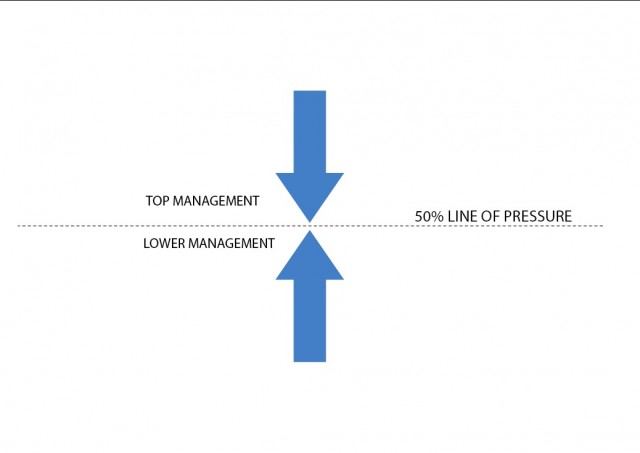
Support and resistance explores the relationship between management and the working structures. There are two types of support and resistance lines.
The zoological industry is made up of two major components: Upper management, where their role is maintaining the longevity of the business itself through major long term planning projects and looking very closely at numerous other projects verse income. And lower management, which keeps an eye on the daily budget, in terms of operation expense. Already two different approaches.
So, the first is the support and resistance line, which is HORIZONTAL line, but the pressure applied is coming from both TOP-DOWN and BOTTOM-UP, which is the pressure between senior management and lower management. These pressures are meant to achieve a balance between staff working well, and sales coming through the door. If staff are causing too many business expenses, then the lower management will be in the firing line. But if tickets aren't selling and infrastructure gets to the point that animals and staff are suffering, then the pressure is reversed.
The job of top management is to maintain resources for the betterment of the business itself and find new ways to promote the business identity. It is relentless, I understand, but so is the work maintaining high standards in animal husbandry. And yet the paid differences is extreme when one side of management, aren't for-filling their roles.
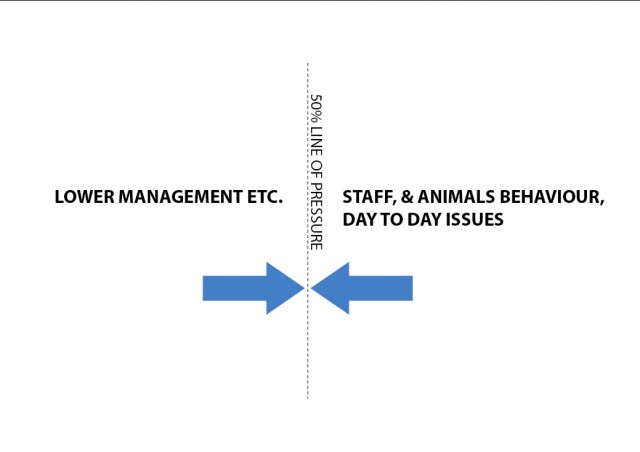
Next is the support and resistance line which is in a VERTICLE manner. Pressure is coming from SIDE-TO-SIDE, which is within either lower management or upper management. But for this example, I will concentrate on the relationships of the lower management, senior and general staff or foot soldiers and sub-contractors, etc.
The vertical line represents the pressure coming within the second half (in this case) between lower management and staff, so it represents one half of the overall business structure.
It is important to understand the differing and various pressures across an organisation. This allows us to predict potential problems and address issues that may arise. Here at Koala Retreat, we are challenging our traditional understanding of what a koala is. Society needs to be better informed and educated to transform the way that we understand and work with the koala. We need to revolutionize everything we know about koalas; from their environment to their diet to their behaviour.
Next Article; About understanding the break-down of both Horizontal and Vertical lines and having a formula to understand and move forward in the koala industry.
52 articles 4 themes 1 story
www.koalaretreat.com